01 / Executive brief
Executive summary
Huawei supplied phones to T-Mobile and needed T-Mobile's protected 'Tappy' robot to test how devices responded to repeated touchscreen use. T-Mobile granted selected Huawei employees controlled lab access under agreements that prohibited photography, reverse engineering, and use beyond testing Huawei handsets. S1S2
A civil jury later found that Huawei Device USA misappropriated T-Mobile trade secrets and breached contractual obligations. It awarded $4.8 million on contract claims, but zero damages for trade-secret misappropriation and no willfulness finding. A later indictment alleged a broader campaign to photograph, measure, and remove part of Tappy for Huawei's own robot program; Huawei pleaded not guilty, and those criminal allegations remained unresolved at review. S1S2S3S4
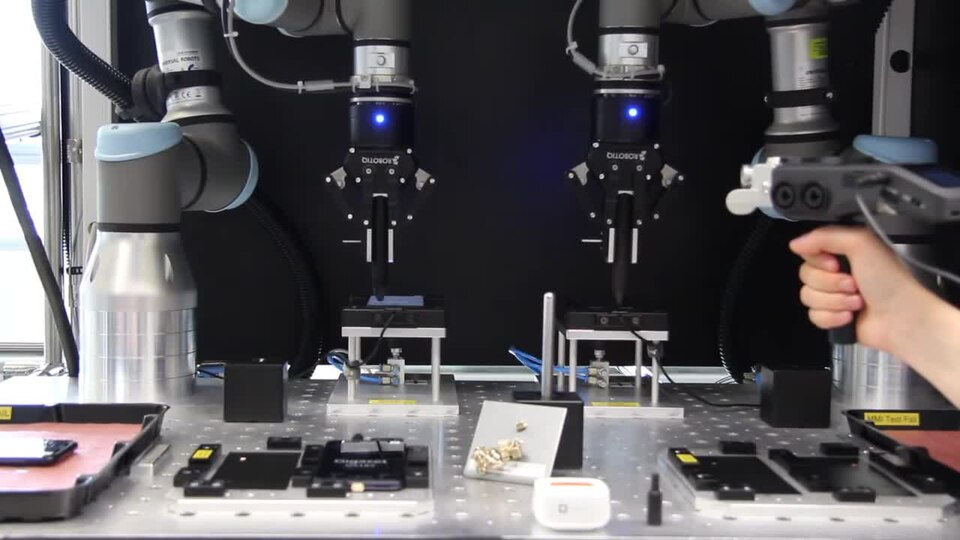
Automated and repeatable device testing can itself become valuable engineering know-how. Tappy tested phone touchscreens; this contextual image shows smartphone quality inspection, not T-Mobile's robot or lab.
Kathinka Engels and Inke Pickhardt · CC BY 3.0 ↗02 / The vignette
What happened
Supplier access came with explicit limits
T-Mobile's test lab gave handset suppliers a valuable way to diagnose device performance before release. Huawei obtained selected access to Tappy because of that commercial relationship, but the permission was narrow: confidentiality agreements barred photography, reverse engineering, and unrelated use. The issue was not that a supplier entered the lab; it was whether trusted access was repurposed. S1S2
Civil findings and criminal allegations diverge
The 2017 civil jury found misappropriation and contract breaches, yet drew important limits around the result: it awarded no trade-secret damages and found no willful or malicious misappropriation. The $4.8 million judgment came from contract claims, not a $4.8 million trade-secret award. S1S3
The federal indictment later alleged unauthorized photographs, measurements, technical requests, removal of a robot-tip component, and transmission of information to engineers building Huawei's xDeviceRobot in China. Those details are accusations, not adjudicated facts. Huawei denied the charges, and an April 2026 order showed the criminal case still in pretrial litigation. S2S3S4
The governance lesson survives the uncertainty
Even with the criminal case unresolved, the civil verdict shows that written restrictions alone did not prevent misuse of protected lab access. Supplier enablement, physical access, and a partner's internal development incentives must be monitored together. This dossier preserves the mixed outcome so leaders can learn from the control failure without converting pending allegations into guilt. S1S2S3S4
03 / Anatomy
How access became transfer
This chain reconstructs the sequence supported by the cited record. It does not imply that every legitimate relationship follows the same path.
- 01
Relationship established
Handset supply agreement
Huawei supplied phones to T-Mobile and depended on T-Mobile's pre-release device-testing process. S2
- 02
Sensitive access gained
Restricted lab permission
T-Mobile allowed selected Huawei employees to use Tappy for phone testing under agreements barring photography, reverse engineering, and unrelated use. S2
- 03
- 04
Assets moved
Information sent to China
The indictment alleges that U.S.-based employees relayed Tappy details to engineers developing Huawei's xDeviceRobot in China. S2
- 05
- 06
04 / Evidence boundary
What is established—and what is not
Established in the record
- A civil jury found that Huawei Device USA misappropriated T-Mobile trade secrets and breached contractual obligations. S1S3
- The same jury awarded no damages for trade-secret misappropriation and did not find the conduct willful or malicious; the $4.8 million award arose from contract claims. S1S3
- T-Mobile's supplier access was conditioned on explicit confidentiality, no-photography, no-reverse-engineering, and limited-purpose rules. S2
Uncertain, limited, or unresolved
- The 2019 criminal indictment is an accusation, not evidence of guilt. Huawei pleaded not guilty, and the prosecution had not reached a verdict at review. S2S4
- The civil verdict established misappropriation but rejected trade-secret damages and willfulness; it cannot be summarized accurately as a $4.8 million trade-secret award. S1S3
05 / Sequence
Timeline
-
Commercial trust established
A handset-supply relationship expanded into controlled Tappy access after Huawei entities signed confidentiality restrictions. S2
-
Technical collection alleged
The indictment describes repeated efforts to obtain Tappy specifications, photographs, measurements, and a component for Huawei's robot effort. S2
-
Criminal indictment filed
A federal grand jury charged Huawei Device entities with offenses arising from the Tappy conduct; the companies later pleaded not guilty. S2
-
Criminal pretrial litigation continues
A court order referred to motions in limine, witness protection, and an upcoming criminal trial, confirming that the broader Huawei prosecution was not resolved. S4
06 / People and institutions
Who appears in the public record
Huawei Device USA, Inc.
T-Mobile handset supplier and civil defendant
Outcome: Civil jury found misappropriation and contract liability; later pleaded not guilty to criminal charges
Huawei Device Co., Ltd.
China-based Huawei entity and criminal defendant
Outcome: Pleaded not guilty; criminal allegations remained pending at review
Originator / affected institution
T-Mobile USA, Inc.
Developer and owner of the Tappy robotic phone-testing system and associated trade secrets
07 / Consequences
Documented and attributed harm
The civil judgment awarded T-Mobile $4.8 million on contract claims, not on the trade-secret claim. S1S3
The jury found no compensable trade-secret loss or unjust enrichment and no willful or malicious misappropriation. S1S3
Prosecutors allege that access shortened Huawei's path to a competing test system, but that alleged criminal consequence remains unadjudicated. S2S4
08 / Hindsight analysis
Where leadership could have seen risk
These are our analytic judgments based on the public record, not court findings. They are framed to improve controls without treating nationality as a risk factor.
Necessary supplier access exposed the asset
T-Mobile needed handset vendors to test products, but that operational requirement also exposed a proprietary test capability to a potential replicator.
Contracts did not enforce themselves
Detailed restrictions framed the duty of care and later litigation, yet physical observation, photography, and technical questioning still required active supervision.
Mixed outcomes invite exaggeration
Leadership decisions should rest on the precise civil findings and pending criminal status, not a compressed narrative that overstates damages or state attribution.
09 / Apply the lesson
Actions leaders can take
- companies
Design observable supplier access
Use escorted sessions, purpose-limited work areas, device controls, session logs, and post-visit review for vendors exposed to unique tools or processes.
- companies
Answer refused requests consistently
Record requests for restricted specifications and ensure employees, affiliates, and regional teams receive one documented answer with escalation for repeated attempts.
- both
Track findings separately
Maintain distinct fields for civil findings, criminal allegations, damages, willfulness, appeals, and state nexus so risk briefings cannot silently convert one into another.
10 / Source record
Sources
Links point to the public record reviewed for this file. Government releases can summarize court proceedings but remain government-authored sources; the source note identifies those limits.
- S1 court record
Jury Verdict: T-Mobile USA, Inc. v. Huawei Device USA, Inc. ↗
U.S. District Court for the Western District of Washington via China IPR · Published May 18, 2017 · Retrieved Aug 23, 2026
Public mirror of docket document 484; the verdict form separates misappropriation, damages, willfulness, and contract findings.
- S2 court record
Indictment: United States v. Huawei Device Co., Ltd. and Huawei Device USA, Inc. ↗
U.S. District Court for the Western District of Washington via U.S. Department of Justice · Published Jan 16, 2019 · Retrieved Aug 23, 2026
Detailed criminal allegations; cited as allegations only because the defendants pleaded not guilty and no verdict had been entered.
- S3 company statement
Statement Regarding T-Mobile's Trade Secret Allegation ↗
Huawei Technologies Co., Ltd. · Published Jan 28, 2019 · Retrieved Aug 23, 2026
Huawei's response stressing the civil jury's zero trade-secret damages, no unjust enrichment, and no willfulness finding.
- S4 court record
Memorandum Decision and Order: United States v. Huawei Technologies Co., Ltd., et al. ↗
U.S. District Court for the Eastern District of New York via GovInfo · Published Apr 13, 2026 · Retrieved Aug 23, 2026
Current procedural evidence that the broader Huawei criminal case remained in pretrial litigation with an upcoming trial.